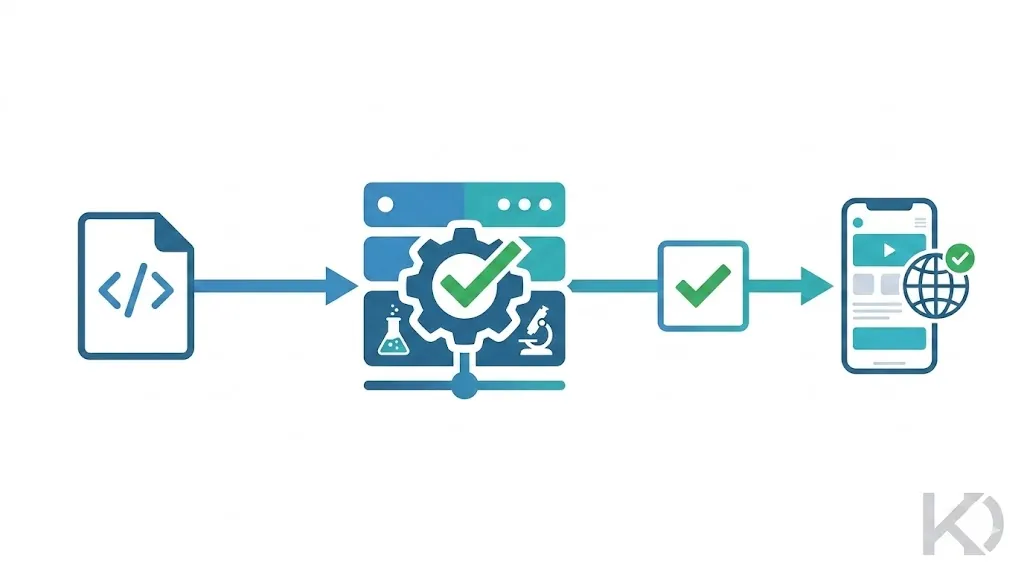
The CI/CD Pipeline: The Automation Engine Driving Modern DevOps Architecture
In the earlier eras of software engineering, launching new features or deploying bug fixes was a high-stakes, nerve-wracking event. Teams routinely bundled months of developer contributions into massive software versions. Code integration was done manually, environments were configured by hand, and "Release Fridays" frequently spun out into chaotic midnight troubleshooting sessions.
The rise of DevOps fundamentally shifted this paradigm. At the heart of this revolution is CI/CD an automated framework designed to bridge the gap between writing code and shipping value to end users. By transforming manual workflows into structured, software driven sequences, CI/CD allows modern product engineering teams to deploy updates multiple times a day with safety, predictability, and speed.
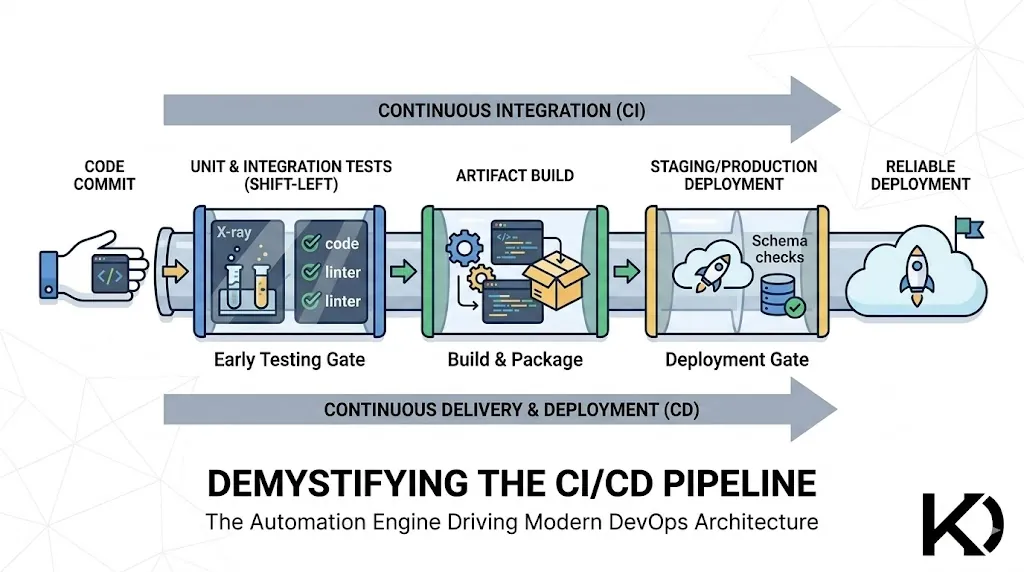
Deconstructing the Architecture: CI vs. CD
While often spoken of as a single entity, CI/CD is an acronym representing distinct, sequential engineering disciplines that cover different phases of the software development lifecycle.
Continuous Integration (CI)
Continuous Integration is focused entirely on the development phase. In a collaborative team environment, multiple engineers write code simultaneously on separate feature branches. Pulling these distinct lines of code back into a single main repository can result in severe architectural friction often called "integration hell."
CI solves this by mandating that developers merge their code changes back into the central branch frequently (often multiple times a day). Every single merge triggers an automated cycle that instantly checks out the fresh code, compiles the application, resolves external dependencies, and runs an automated test suite. If a newly introduced line of code breaks existing business logic, the build fails immediately, preventing the defect from polluting the main codebase.
Continuous Delivery vs. Continuous Deployment (CD)
Once the code passes the integration stage, the "CD" phase takes over. Depending on organizational workflows, CD can follow one of two paths:
| Paradigm | Operational Definition | Human Intervention |
|---|---|---|
| Continuous Delivery | Code is automatically built, verified, and pushed to a production-ready staging environment. The software is always deployable, but waiting for an executive decision to go live. | Manual Approval Required |
| Continuous Deployment | Every valid code change that passes the continuous integration automated test gates is launched directly to production servers automatically. | 100% Fully Automated |
What is a "Pipeline" in a Technical Aspect?
To understand how code transforms into a live product, one must understand the technical concept of a pipeline. In software engineering, a pipeline is an automated, directional sequence of processes executed by specialized infrastructure. The core principle mirrors a physical assembly line: the immutable output of one step serves as the direct, isolated input for the subsequent step.

Architecturally, pipelines are defined as configuration files written in structured notation, usually YAML, stored right alongside the source code. Under the hood, a pipeline relies on three main technical entities:
- Triggers: Event-driven webhooks that listen to git state changes. Examples include a code push to a main branch, the opening of a Pull Request, or a time-based cron schedule.
- Runners / Agents: Ephemeral, isolated execution environments often clean virtual machines or temporary Docker containers where compilation and code execution take place.
- Artifacts: The immutable, compiled packages yielded by successful pipeline steps (such as a Docker image, a compiled binary, or a minimized frontend build folder) which are archived and ready for deployment.
Test Automation: The Ultimate Gatekeeper
Velocity without verification is catastrophic. Accelerating deployment loops using automation is worthless if it simply accelerates the rate at which system defects and regressions are shipped to production. Therefore, test automation is the absolute core requirement of any functional CI/CD ecosystem.
Pipelines act as strict quality gates by relying on automated validation steps. To maintain a fast execution speed without sacrificing security and architectural integrity, modern software engineering structures test suites according to the Testing Pyramid:
The Testing Pyramid Architecture within CI/CD
- Unit Tests (The Foundation): Thousands of small, rapid tests verifying individual code functions in absolute isolation using mock data structures. Because they execute in milliseconds, they provide immediate feedback to developers, acting as the primary CI filter.
- Integration & API Tests (The Core): Middle-tier tests verifying the interfaces, contracts, and data movement across internal microservices, database connections, and external API integrations.
- End-to-End (E2E) & Smoke Tests (The Apex): Heavy UI automated tests using frameworks like Playwright or Cypress. They orchestrate headless browsers to mimic true human navigation paths on a staging server before live delivery.
This structured strategy achieves what the industry terms Shift-Left Testing. Instead of discovering bugs late in the engineering cycle or worse, discovering them in production automated testing moves verification to the absolute beginning of the development flow. When an execution fails at any layer of the pyramid, the pipeline immediately stops the process, logs execution telemetry, and fires synchronous alerts to the engineering team.
Conclusion
Implementing a CI/CD pipeline shifts a software organization from reactive, manual system maintenance to a proactive, reliable, and continuous engineering delivery workflow. By establishing precise triggers, clean environment automation, and rigorous testing layers, engineering groups can focus on building high-impact code, leaving the complex choreography of compiling, testing, and cloud deployment to the automation engine.
Kavishka Dulshan