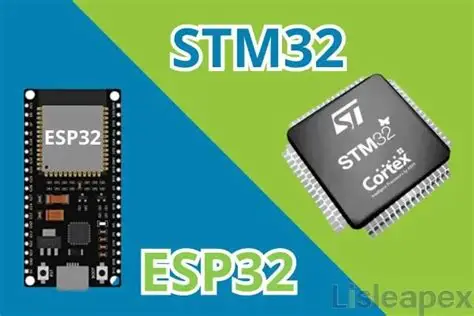
ESP32-S3 vs. STM32H7: Which Powerhouse for Your Project?
When it comes to high-performance microcontrollers, the ESP32-S3 and the STM32H7 represent two of the most popular choices for developers today. While both are considered "powerhouses," they excel in very different environments.
Technical Specifications
Understanding the raw hardware is the first step in deciding which chip fits your requirements.
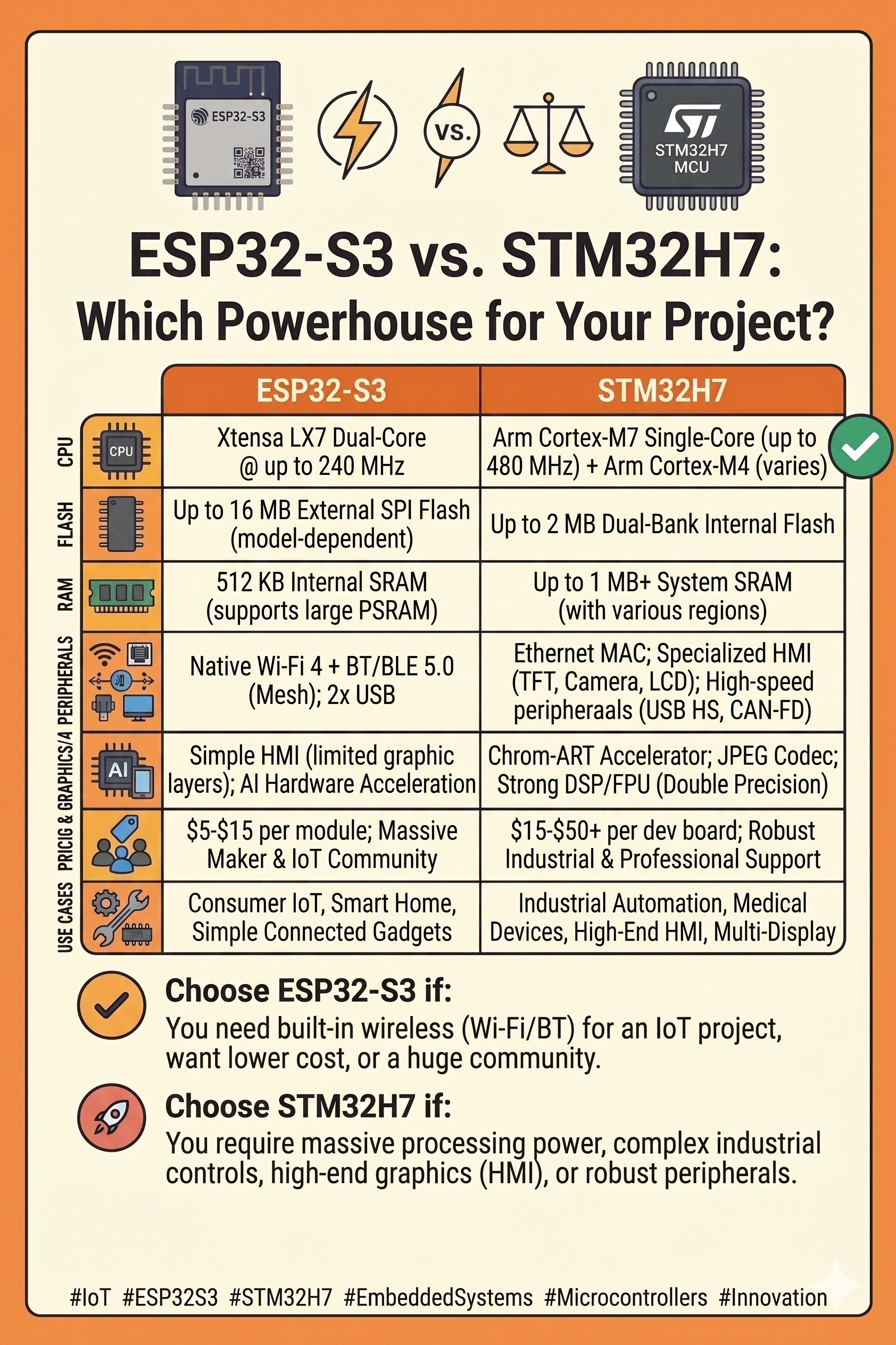
| Feature | ESP32-S3 | STM32H7 |
|---|---|---|
| CPU | Xtensa LX7 Dual-Core @ up to 240 MHz | Arm Cortex-M7 Single-Core (up to 480 MHz) + Arm Cortex-M4 (varies) |
| Flash | Up to 16 MB External SPI Flash (model-dependent) | Up to 2 MB Dual-Bank Internal Flash |
| RAM | 512 KB Internal SRAM (supports large PSRAM) | Up to 1 MB+ System SRAM (with various regions) |
| Connectivity | Native Wi-Fi 4 + BT/BLE 5.0 (Mesh); 2x USB | Ethernet MAC; High-speed peripherals (USB HS, CAN-FD) |
| Graphics/AI | Simple HMI; AI Hardware Acceleration | Chrom-ART Accelerator; JPEG Codec; Strong DSP/FPU |
| Pricing | $5-$15 per module | $15-$50+ per dev board |
Connectivity and IoT
The ESP32-S3 is the undisputed king of wireless connectivity. With native Wi-Fi 4 and Bluetooth 5.0 (including Mesh support) built directly into the silicon, it is designed for the modern IoT landscape. If your project needs to talk to the cloud or a smartphone out of the box, the ESP32-S3 is the most cost-effective and space-efficient solution.
In contrast, the STM32H7 focuses on wired reliability and industrial standards. While it lacks built-in Wi-Fi, it features an Ethernet MAC and advanced communication protocols like CAN-FD, making it better suited for factory floors or automotive applications where wireless interference is a concern.
Graphics and Processing Power
If your project requires a high-resolution display or complex user interface (HMI), the STM32H7 is built for the task. It includes a dedicated Chrom-ART Accelerator and a JPEG codec to handle graphical heavy lifting without taxing the main CPU.
The ESP32-S3 can handle simple HMI and limited graphic layers, but its real strength in processing lies in its AI hardware acceleration. It is optimized for edge computing tasks like wake-word detection or simple image recognition.
Community and Support
The ESP32-S3 benefits from a massive "Maker" and IoT community. Finding libraries for sensors, community forums for troubleshooting, and cheap development modules is incredibly easy.
The STM32H7 is backed by robust industrial and professional support. STMicroelectronics provides a deep ecosystem of professional development tools (STM32Cube) and long-term supply guarantees, which are critical for medical devices and industrial automation.
Summary: Which should you choose?
Choose ESP32-S3 if:
- You need built-in wireless (Wi-Fi/BT) for an IoT project.
- You want lower hardware costs.
- You want to leverage a huge community and existing libraries.
- You are building consumer gadgets or smart home devices.
Choose STM32H7 if:
- You require massive processing power (up to 480 MHz).
- Your project involves complex industrial controls or high-end graphics (HMI).
- You need robust, high-speed wired peripherals like Ethernet or CAN-FD.
- You are developing medical or industrial-grade hardware.
Both chips are incredible pieces of engineering. Your choice ultimately depends on whether your project lives in the "connected consumer" world or the "high-performance industrial" world.